If your battery keeps dying overnight, it is tempting to blame the battery itself. And sometimes you should: an old or weak battery can absolutely give up overnight, especially in cold weather. But one of the most common repeat offenders is a parasitic draw: something in the car staying awake and sipping power after you shut the key off. The good news is you can track it down at home with a multimeter, a little patience, and the kind of methodical approach that keeps you from losing your mind in the fuse box.
This is the exact process I used in the shop and still use in my own driveway. We are going to measure key-off current draw, then isolate the circuit by pulling fuses, and finally narrow it to the specific component that is misbehaving.

What parasitic drain looks like
A modern car always uses a small amount of power with the key off. The clock, radio memory, security system, and a few modules need to stay alive. That is normal.
- Typical key-off draw for many vehicles: roughly 20 to 50 milliamps (0.02 to 0.05 A) once everything goes to sleep.
- Depends on the car: some late-model vehicles may legitimately sit a bit higher after full sleep. Many OEM specs land somewhere under roughly 50 to 70 mA, but the correct number is whatever your manufacturer calls acceptable.
- Borderline: 50 to 100 mA can be too high on some cars, especially if you do not drive often, the battery is older, or temperatures are low.
- Problem: 100 mA+ after full sleep often means the battery can be dead in a day or two. A few hundred milliamps can absolutely kill a battery overnight, depending on battery health and capacity.
Important: some cars take a while to “go to sleep.” If you test too soon, you will swear you have a drain when you do not. We will handle that in the setup.
Tools and supplies
- Digital multimeter with a fused 10A (or higher) current port
- Test leads with alligator clips (nice to have, not mandatory)
- Wrench for battery terminals (often 10mm, because of course it is)
- Fuse puller or needle-nose pliers
- Small flashlight
- Pen and paper or phone notes for tracking fuse results
Optional but very helpful: a DC clamp meter with true low-current (mA) resolution, or a low-amp clamp adapter. Many clamp meters are great for big currents but are not accurate down in the tens of milliamps range. This guide assumes a regular multimeter since most DIYers already have one.
Safety: do not smoke your multimeter
Measuring current is different from measuring voltage. When you measure amps, the meter becomes part of the circuit. If you do it wrong, you can pop the meter fuse instantly or worse.
- Do not try to start the car or crank the engine with the meter in series. Starter current is huge and will blow the meter fuse immediately.
- Begin on the 10A range and the correct meter port. If your meter has a separate 10A jack, use it.
- Keep doors closed and lights off so you do not wake modules during the test.
- If you need the hood open, some vehicles have a hood-ajar switch. If you need the car to think the hood is shut, you can carefully click the hood latch closed with a screwdriver. Before you shut the hood again, pull the hood release and re-open the latch, or you will be that person yanking on a hood that will not open.
If any of this feels stressful, grab a friend to help hold a cable steady, and take it slow. Slow is smooth, smooth is fast.
Step 1: rule out battery and charging issues
Parasitic drain is common, but do not skip the basics.
- Battery health: If the battery is old (4 to 6 years is a typical lifespan), it can fail even with a normal draw.
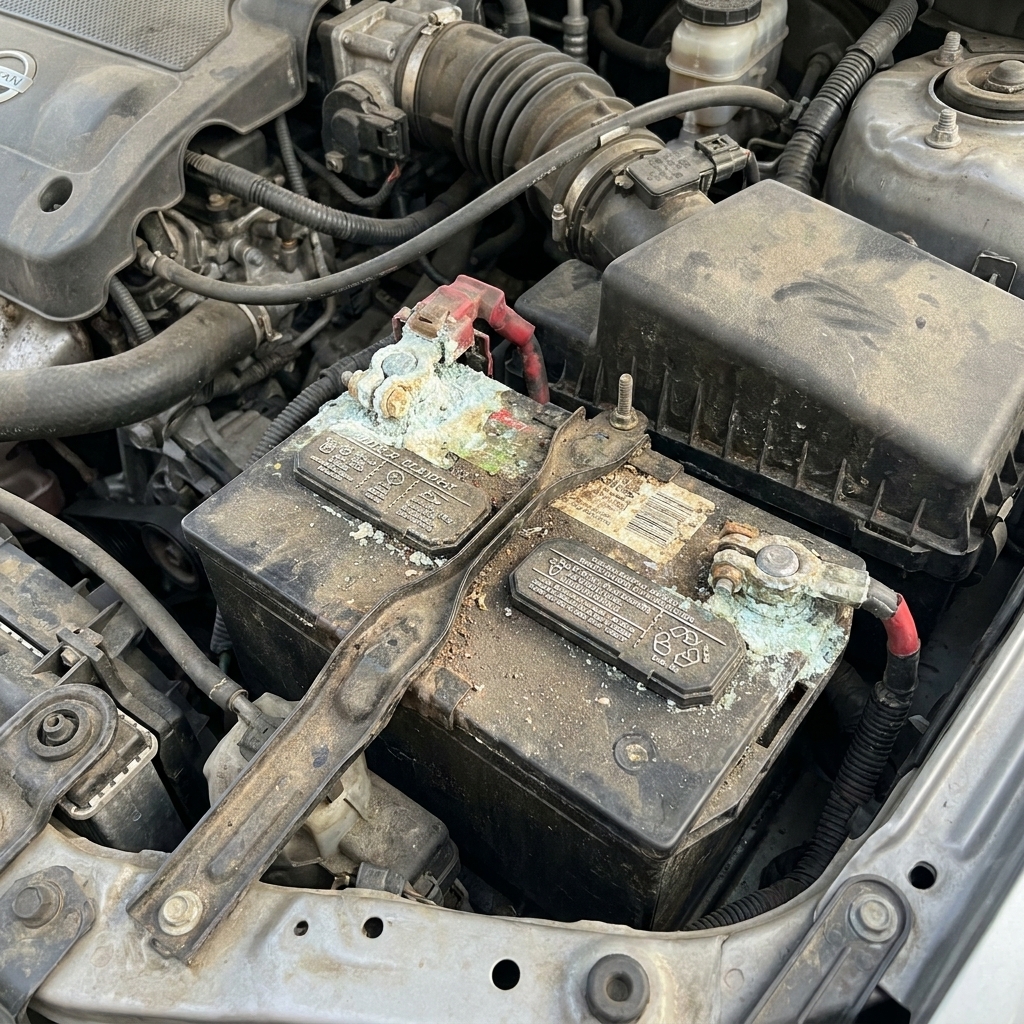
- Loose or corroded terminals: A poor connection can mimic a dead battery.
- Alternator output: If the alternator is not charging, you can chase a “drain” forever.
Quick driveway check: with the engine running, many cars will show around 13.8 to 14.6 volts at the battery. Some smart-charging systems may vary depending on conditions, but if you are sitting at 12.2V running, that is a charging problem to solve first.
Step 2: let the car go to sleep
To get an honest parasitic draw reading, you need the car in its normal key-off state.
- Turn the car off, remove the key, and keep it away from push-button cars (key fobs can wake systems).
- Close all doors. If you must leave a door open for fuse access, manually latch the door striker so the car thinks the door is closed.
- Turn off interior lights, headlights, and anything plugged into 12V outlets.
- Wait for modules to time out. This can take 10 to 45 minutes depending on the vehicle.
If you are not sure how long your car needs, plan for 30 minutes. Put on a song, drink coffee, and let it settle down.
Small heads-up: disconnecting battery power or waking modules repeatedly can reset things like radio presets, window indexing, and some driver settings. It is not the end of the world, but it is normal.
Step 3: measure key-off draw
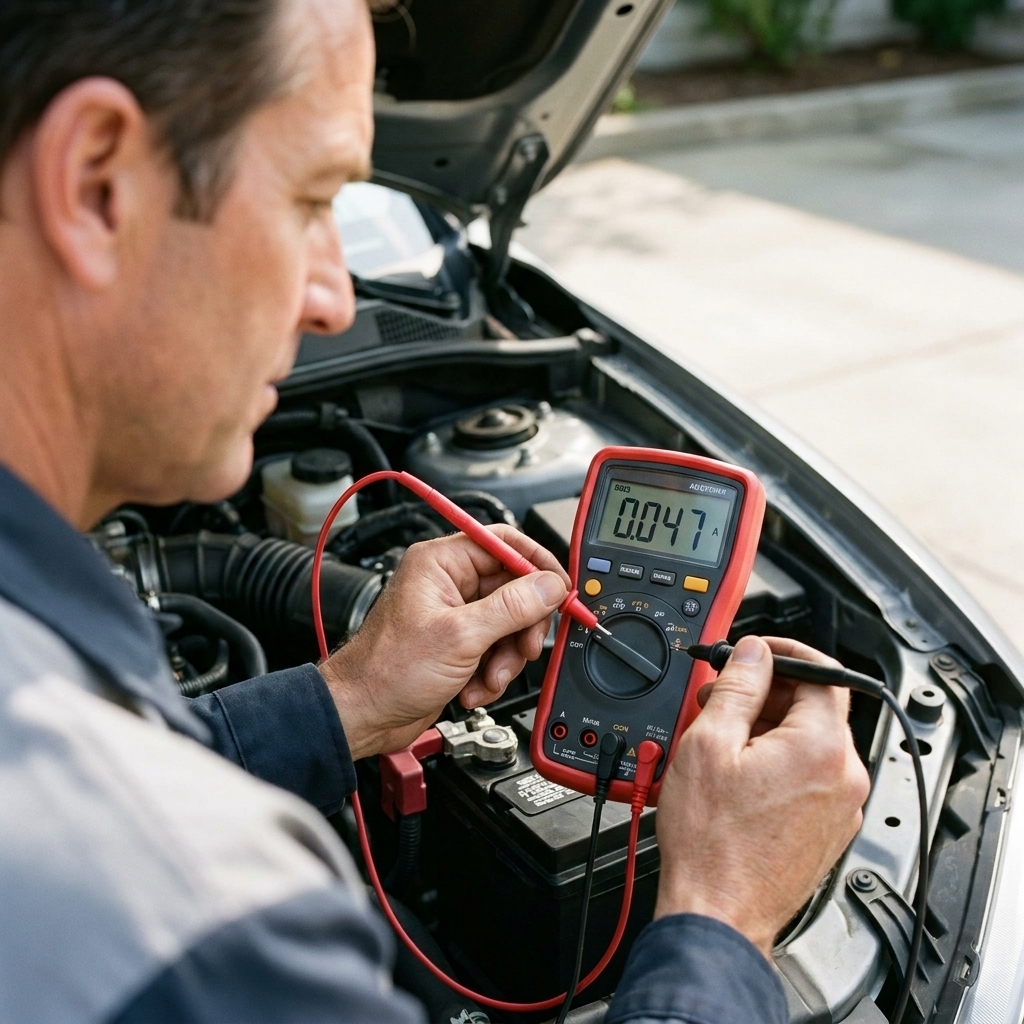
We are going to place the meter in series between the battery post and the battery cable so all current flows through the meter.
Which cable to disconnect
Use the negative cable whenever possible. It reduces the chance of accidentally shorting your wrench to body metal and creating sparks.
Series setup
- Set the multimeter to DC amps (A⎓). Start on the 10A scale.
- Move the red lead to the 10A (or high current) port. Black lead goes to COM.
- Loosen and remove the negative battery cable from the battery post.
- Connect the meter black lead to the battery negative post.
- Connect the meter red lead to the removed negative battery cable end.
Clarifier (because this trips people up): the meter must bridge the gap between the post and the removed cable end. One probe touches the battery post, the other touches the cable end, so the only path for current is through the meter.
You have now bridged the connection through the meter. Do not bump the leads loose. A momentary disconnect can wake modules and reset your waiting period.
What you should see: At first, the reading may be higher as modules wake up. After the sleep period, it should drop and stabilize.
If the reading is low
If you end up below 0.10A (100 mA) and your meter supports a lower range, switch to the mA range for better resolution. Only do this after you are confident the draw is low, because most meters have a much smaller fuse on the mA port.
Optional: the “no-break” jumper trick
If you want to reduce the chance of wake-ups and spikes, you can keep the circuit alive while you insert the meter. Use a fused jumper wire or a heavy test lead to connect the negative cable to the negative post first, then set up the meter leads, then remove the jumper so the meter becomes the only path. This is a very common technician move when a vehicle is picky about being disturbed.
Step 4: pull fuses to isolate the circuit
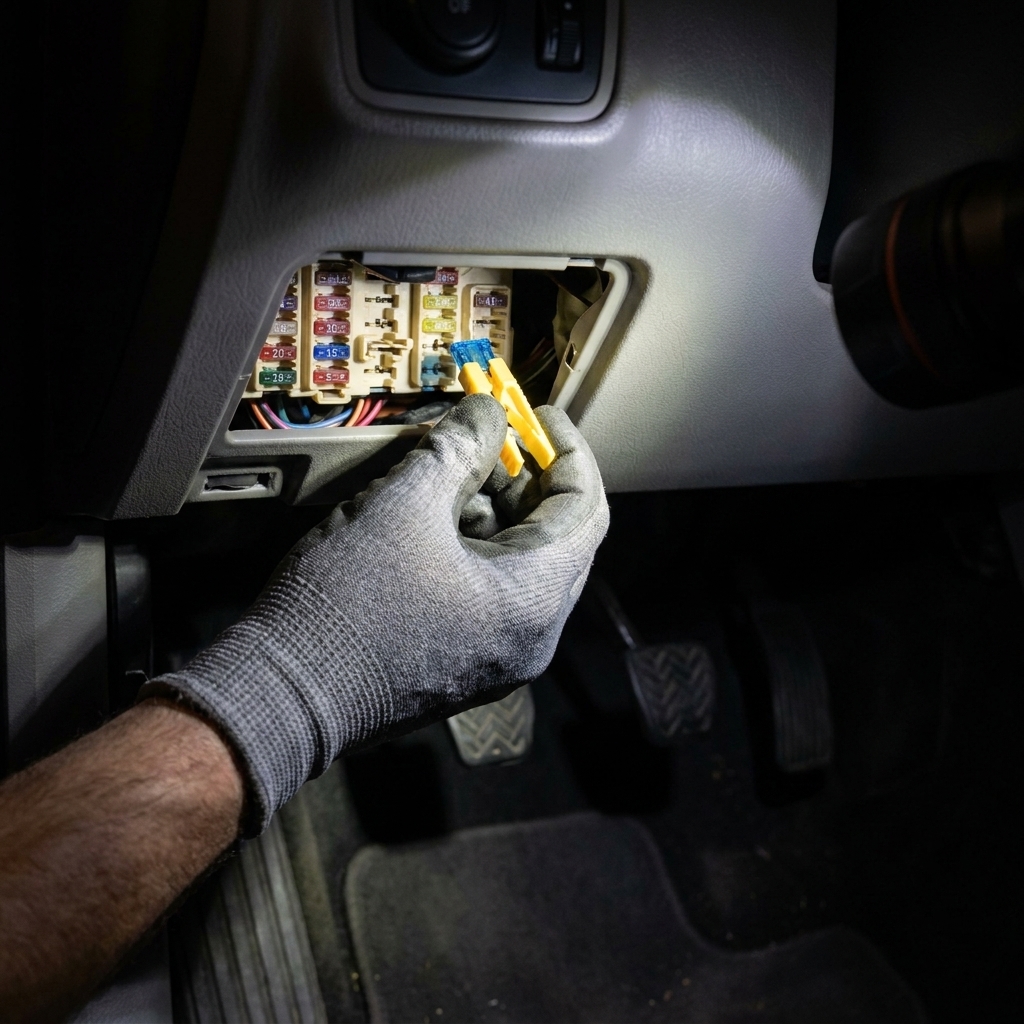
This is where the mystery drain turns into a specific circuit. Pull one fuse at a time while watching the amp draw. When the draw drops noticeably, you just found the circuit feeding the drain.
What counts as a big drop? You are looking for a drop that basically explains the problem. If you started at 0.30A (300 mA) and pulling a fuse takes you to 0.04A (40 mA), that fuse matters. If it drops from 0.30A to 0.28A, that is probably not your main issue.
How to pull fuses without waking the car
- Start with the interior fuse panel first. It usually contains the body control circuits that cause most parasitic drains.
- Use a fuse puller and be gentle. Do not open doors repeatedly or flip switches.
- Give the meter reading a few seconds to settle after each fuse pull.
- Write down each fuse location and the before and after reading.
Tip from a guy who has done this a lot: Pull and reinstall fuses in an organized pattern. Left to right, top to bottom. It is very easy to forget what you pulled when you are 18 fuses deep.
Step 5: use the fuse label
Once you identify the fuse that causes the big drop, look it up in the owner’s manual or the fuse box legend. That fuse will usually power a short list of items. Now you are no longer guessing.
Example: if pulling “ROOM LAMP” drops your draw from 0.35A to 0.03A, you are looking for something on the interior lighting circuit: glove box light, trunk light, vanity mirror light, or a stuck door switch.
Common culprits
- Glove box or trunk light stuck on (often invisible in daylight)
- Aftermarket stereo, amplifier, dash cam wired to constant power instead of switched power
- Stuck relay for radiator fans, fuel pump, or accessories
- Bad door latch or door ajar switch keeping body modules awake
- Keyless entry issues where the car never fully sleeps
- Shorted alternator diode (drain persists even with fuses pulled, more on this below)
Step 6: find the exact part
After you identify the problem fuse, you have a few ways to pinpoint the exact component.
Method A: unplug items one at a time
With the fuse installed again and the meter still connected, unplug items on that circuit one by one until the draw drops. For example:
- Unplug glove box light switch or lamp connector
- Unplug trunk lamp
- Unplug an aftermarket accessory on that circuit
When the draw drops back to normal, the last thing you unplugged is your culprit or is on the branch feeding it.
Method B: relay check
If the fuse powers a relay-controlled system, touch the relay after the car has been off for a while. A relay that is warm when it should be asleep is suspicious. You can also swap it with an identical relay (only if you are sure it is the same part number and function is non-critical) and see if the drain changes.
Method C: look for the always-on clue
Lights are the classic. In a dark garage, look for a faint glow in the trunk, glove box, or under-hood service light. Sometimes you can spot it through a tiny gap.
If fuses do nothing
If you pull every fuse you can reasonably access and the draw stays high, do not panic. That usually means the drain is on an unfused high-current path, a circuit in a different fuse box, or an add-on wired directly to the battery.
Two big checks
- Alternator: A shorted diode can backfeed and drain the battery. The safer first move is unplugging the alternator’s electrical connector and watching for a draw drop. Disconnecting the alternator B+ cable can also isolate it, but only do that with the battery disconnected first and only if you can do it safely without short hazards. If the draw drops when the alternator is isolated, the alternator is the suspect.
- Starter cable or direct-to-battery wiring: Amplifiers and winches sometimes have inline fuses near the battery. Check those add-ons.
Also check the under-hood fuse box. Many vehicles have multiple panels, and the drain may live in the engine bay panel.
Fixes that solve it
Once you know the circuit and component, the fix is usually straightforward:
- Light staying on: adjust or replace the switch, repair the latch, replace the lamp housing if it is damaged.
- Aftermarket accessory: rewire to a true ignition-switched source using a proper add-a-fuse and correct fuse sizing, or add a relay triggered by ignition power.
- Relay stuck: replace the relay, then confirm the control side is not commanding it on (a module or sensor issue can hold it energized).
- Module not sleeping: sometimes solved with a software update, latch repair, or replacing the offending module. This is where a factory scan tool helps, but your fuse test still points you in the right direction.
- Alternator diode: replace alternator or rebuild, then re-test key-off draw.
After the repair, repeat the current draw test and confirm you are back in a normal range after the vehicle goes to sleep.
Quick troubleshooting table
| Symptom | Likely cause | Next move |
|---|---|---|
| Battery dead overnight, draw is 0.2A to 1.0A+ | Light, relay, or aftermarket accessory | Pull fuses and watch for a big drop |
| Draw starts high then drops slowly | Normal module sleep behavior | Wait longer, do not open doors |
| Pulling interior fuses does nothing | Under-hood circuit, alternator diode, direct-to-battery accessory | Check under-hood panel and alternator connector |
| Draw is normal but battery still dies | Weak battery or no charge | Load test battery, verify charging voltage |
FAQ
How long should I wait for sleep mode?
Many cars settle within 10 to 20 minutes. Some take 30 to 45 minutes. If you see the draw stepping down in stages, that is a sign modules are timing out normally.
Can I do this without disconnecting the cable?
Not with a standard multimeter in series. If you have a true low-current DC clamp meter that can resolve milliamps accurately (or a low-current clamp adapter), you can clamp around the battery cable without disconnecting anything. That tool makes this job much easier.
Will pulling fuses damage anything?
Generally no, but it can reset radio presets or wake modules, which changes the draw temporarily. That is why patience matters. Pull one fuse at a time, wait for the reading to stabilize, and keep the car undisturbed.
My multimeter fuse blew. What did I do wrong?
Most often: the leads were in the mA port while the draw was higher than the meter’s mA fuse rating, or the car was accidentally woken up and a high-load circuit turned on. Replace the meter fuse with the correct type and rating, then restart on the 10A port and range.
Wrap-up
A parasitic drain feels like electrical voodoo until you put a number on it. Once you measure the key-off draw and isolate the circuit with fuses, the problem becomes a normal troubleshooting job: one circuit, a handful of components, one guilty part.
If you want a second set of eyes, jot down your resting draw reading, which fuse caused the drop, and what the fuse label says it powers. That little notebook-style discipline is how you beat electrical gremlins without throwing parts at the car.