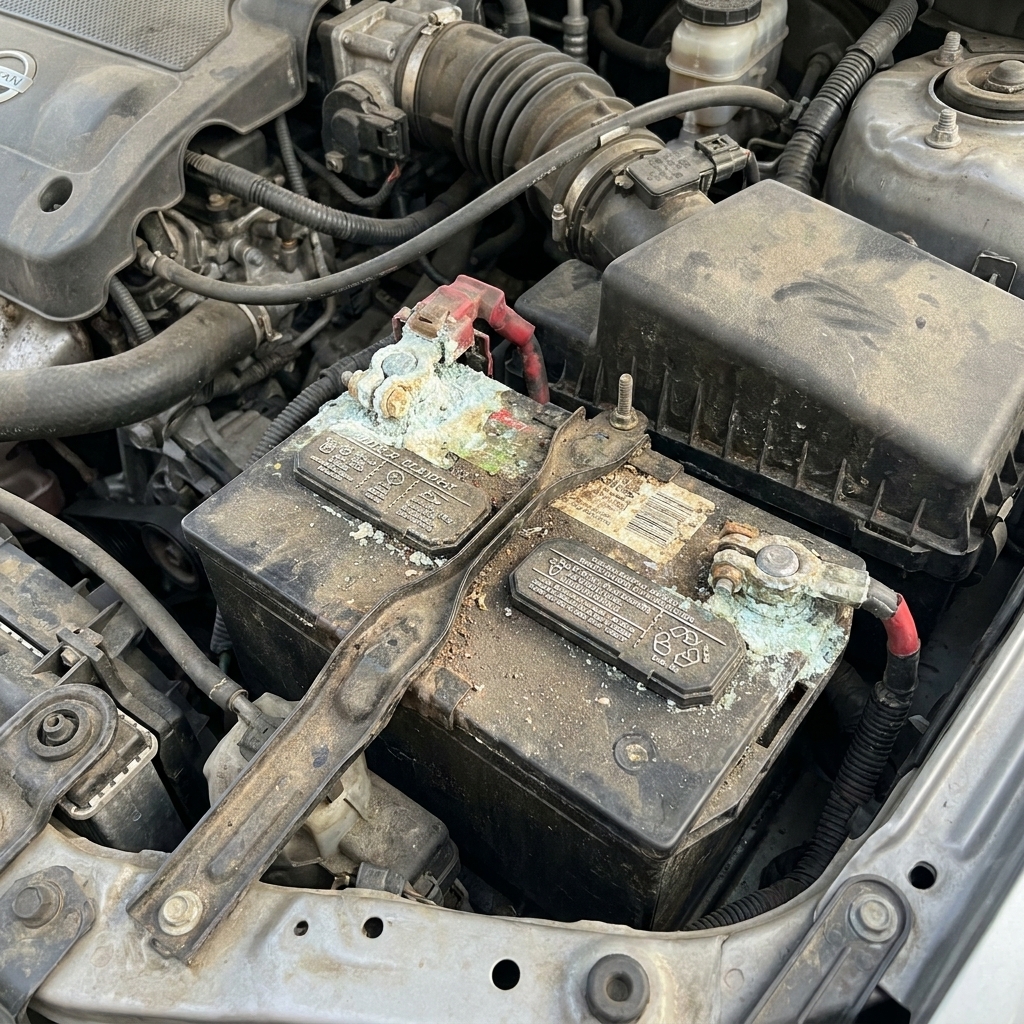
If your car starts fine all week, then randomly greets you with a dead battery after sitting overnight, you are not imagining things. Modern cars do draw a small amount of power when parked, but when something stays awake (or stays on), it can drain a healthy battery fast.
In this guide, I will walk you through a parasitic draw test the same way I did in the shop: safe, methodical, and repeatable. You will measure the draw, confirm it is excessive, isolate the circuit, then narrow it down to the exact component.
First, rule out the obvious stuff
A parasitic drain is common, but it is not the only reason a battery dies. Before you break out the meter, take five minutes to check the basics. This saves a lot of false alarms.
1) Make sure the battery is actually healthy
- Age matters: Most car batteries live 3 to 5 years, but heat, cold, and short-trip driving can shorten that. A 6-year-old battery can pass a casual “it started yesterday” check and still fail overnight.
- Quick voltage check (engine off, after sitting): Rough numbers for a lead-acid battery at about room temperature, after the surface charge has dissipated: around 12.6V is fully charged, around 12.2V is about half, and anything near 12.0V is basically flat. Temperature changes the story, so treat this as a guideline, not gospel.
- Load test if you can: Many auto parts stores will test for free. A weak battery makes a normal, small draw look like the villain.
2) Check charging system basics
With the engine running, many vehicles will show about 13.8V to 14.6V at the battery.
One catch: a lot of newer cars use smart charging. Depending on battery state of charge, temperature, and load, you might see it cruise down in the 12.5V to 13.2V range at times, or bump higher during conditioning. If you are consistently seeing low voltage and the battery keeps going dead, then you may have an undercharging problem. If you see voltage that moves around, that can be normal on modern systems.
3) Look for “something left on”
Glove box lights, trunk lights, under-hood lights, and aftermarket accessories are repeat offenders. At night or in a dark garage, look through the windows for any interior glow and check the trunk and glove box with your phone camera if needed.
What counts as a normal parasitic draw?
Cars keep a few things alive when parked: security system, keyless entry receiver, clock, radio memory, and multiple modules that go to sleep after a delay. That is normal.
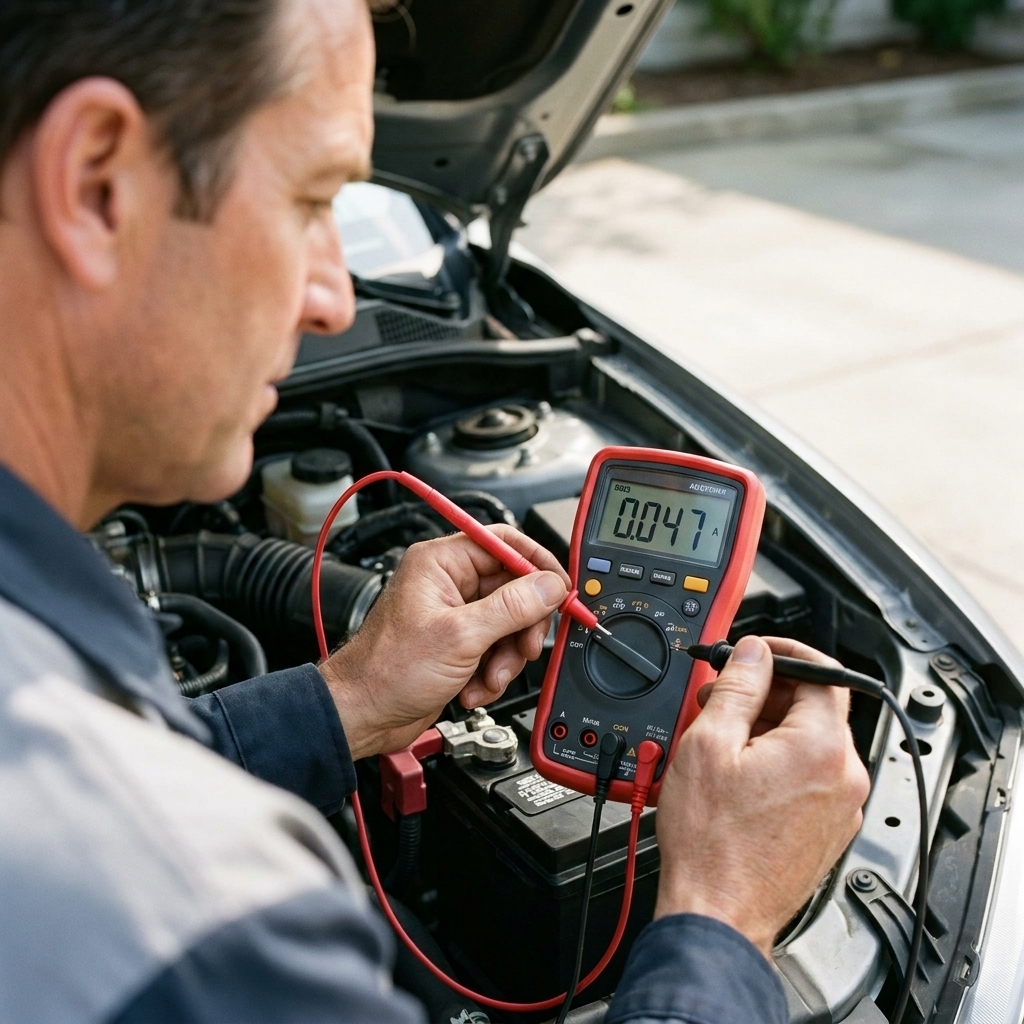
- Typical healthy key-off draw: about 20 to 50 milliamps (0.02 to 0.05A)
- Often acceptable on newer cars: up to 80 milliamps (0.08A) depending on model and equipment
- Usually a problem: sustained draw of 150 milliamps (0.15A) or higher
Important: do not judge the draw right after shutting the car off. Many vehicles stay awake for 10 to 45 minutes before going into sleep mode.
Also, some cars with telematics will wake up briefly and spike the draw now and then. What you are looking for is a sustained draw that never settles, or a pattern of frequent wake-ups that drains the battery over time.
Tools you need (and what to avoid)
- Digital multimeter that can measure amps and has a fused amp input. A clamp meter that reads DC milliamps also works and is safer, but not everyone has one.
- Wrenches or sockets for the battery terminals (usually 10mm).
- Fuse puller or needle-nose pliers.
- Pen and paper or your phone for notes. Trust me, you will forget which fuses you pulled.
- Optional but helpful: a small jumper wire with alligator clips. This makes it easier to keep continuity while you put the meter in series.
Avoid: using the multimeter on the amps setting across the battery posts like you would for voltage. That is a quick way to pop the meter fuse or damage the meter.
Setup tips that prevent headaches
Keep the car “asleep” while you test
The moment you open a door, hit unlock, or wake the infotainment, the draw spikes and your readings become meaningless.
- Roll down a window first so you can reach in if needed.
- Turn the interior lights off manually if your car has a switch or dial.
- If you need the hood physically open but the car thinking it is closed, latch the hood latch with a screwdriver (only if you understand how to unlatch it safely afterward).
- If you need access to the interior fuse panel: you can do the same trick with the driver’s door. With the door open, use a screwdriver to click the door latch to the “closed” position so the car thinks the door is shut while you can still reach the fuses. When you are done, pull the inside door handle (or use the lever on the latch) to reset it before closing the door.
- Keep the key far away from the car if it is push-button start.
Do not try to crank the engine with the meter inline
Starter current is huge and will blow the meter fuse instantly. This test is key-off only.
Step-by-step: parasitic draw test with a multimeter
We are going to put the multimeter in series between the battery post and the cable so all the car’s key-off power flows through the meter.
Step 1: Charge the battery
Start with a fully charged battery if possible. A weak battery can cause modules to behave strangely and can skew your results.
Step 2: Plan the “handoff” (so you do not wake everything up)
Here is the part most DIYers skip. If you simply disconnect the battery cable, you may reset modules, wake systems back up, and you can get a big inrush when you reconnect through the meter.
If you have a small jumper wire with alligator clips, do this:
- With the car off, connect the jumper wire between the negative battery post and a clean metal part of the negative cable clamp. This keeps power flowing while you loosen the clamp.
- Loosen and lift the negative cable off the battery post, while the jumper is still carrying the load.
- Set up your meter leads (next step), then remove the jumper so current flows through the meter instead.
No jumper wire? You can still do the test. Just be aware that you may have to wait through another sleep cycle after you connect the meter.
Step 3: Set the multimeter up correctly
- Move the red test lead to the meter’s amps port (often labeled
Aor10A). - Set the dial to DC amps. If your meter has a 10A range and a mA range, start on 10A so you do not blow the smaller fuse.
Step 4: Disconnect the negative battery cable
Use the negative side for testing. It reduces the chance of accidentally shorting the positive terminal to body metal.
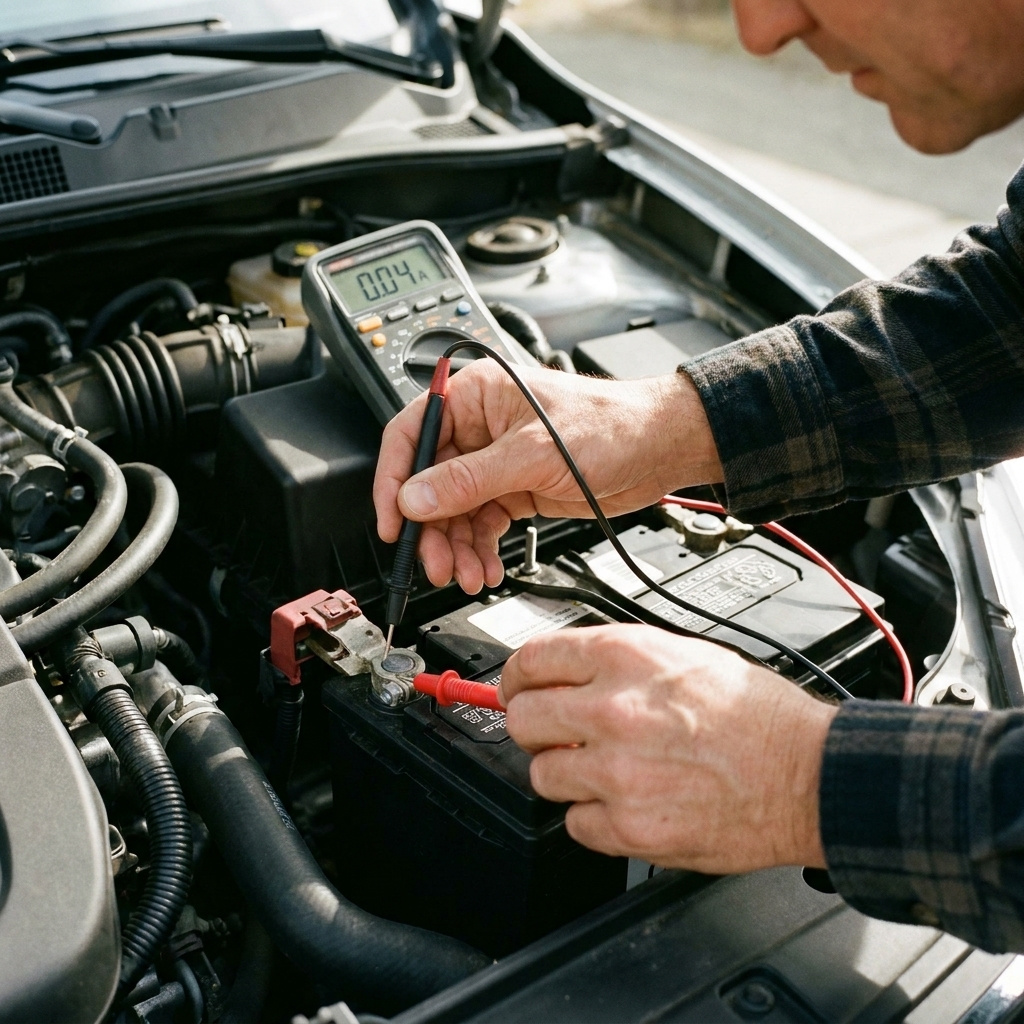
Step 5: Connect the meter in series
- Connect the black meter lead to the negative battery post.
- Connect the red meter lead to the disconnected negative battery cable.
You have now bridged the gap in series with the meter.
Let the car go to sleep
Right after you connect the meter, you may see a higher reading like 0.5A to 2A. That can be normal for a few minutes while computers shut down.
- Wait the factory sleep timeout: at least 15 minutes, and up to 45 minutes on many newer vehicles.
- Do not touch the car, open doors, or press the key fob.
Once it stabilizes, note the reading.
For better accuracy: switch to the mA range
After the draw settles and you are sure it is under your meter’s mA fuse limit, switch to the mA range for better resolution. Two important rules:
- Move the red lead to the correct mA jack if your meter requires it.
- When you are done, move the lead back to the normal volts/ohms jack. People forget this all the time, then wonder why the meter “doesn’t work” on the next job.
Interpreting what you see
- 0.02A to 0.08A: usually normal.
- 0.10A to 0.20A: suspicious. Might kill a battery over a few days, faster in cold weather.
- 0.30A and up: strong chance you have a real drain that can cause a no-start quickly, especially if the battery is not 100% or the weather is cold.
Isolate the drain: the fuse-pull method
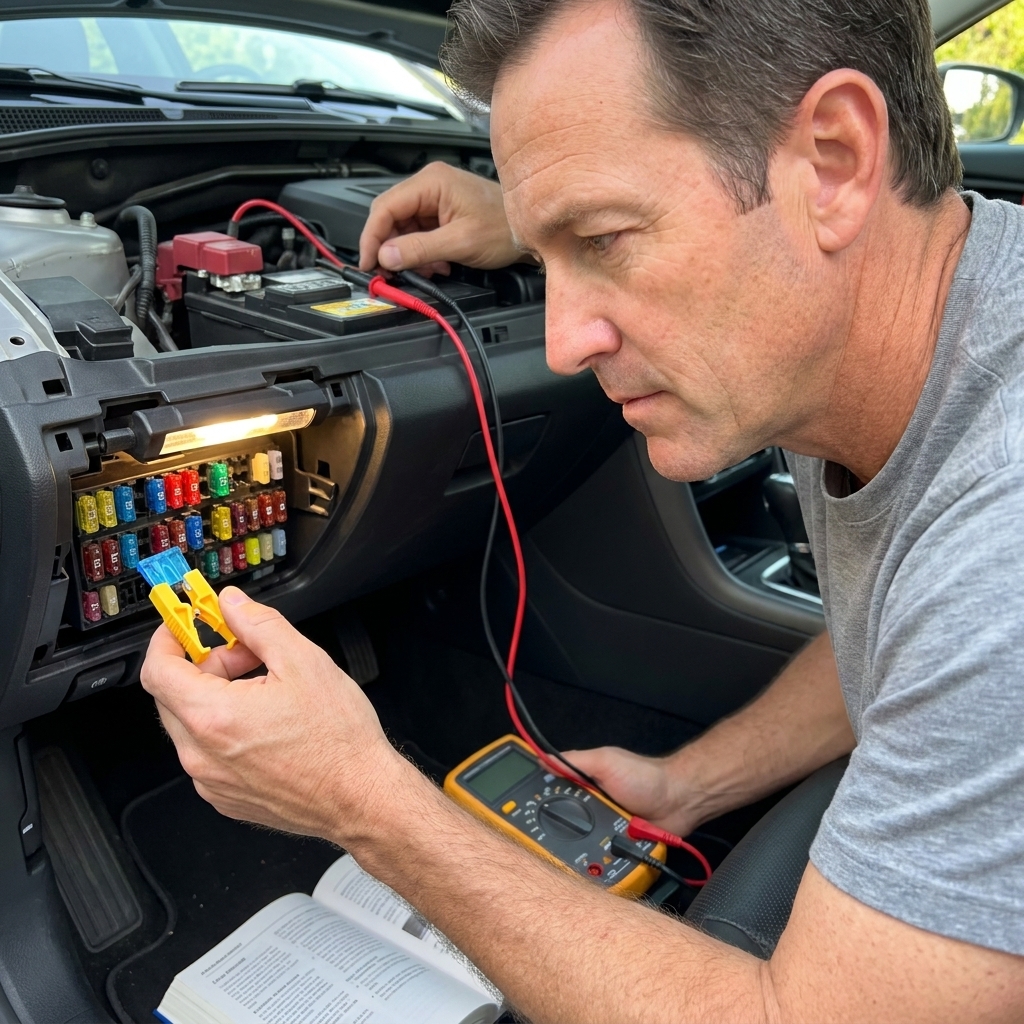
Once you have confirmed excessive draw, the fastest way to find the problem is to pull fuses one at a time and watch the meter. When the reading drops significantly, you found the circuit feeding the drain.
Step 1: Locate the fuse boxes
Most vehicles have at least two: one under the hood and one in the cabin (often by the driver’s knee or behind a panel).
Step 2: Pull one fuse, watch the meter, reinstall it
- Pull a fuse.
- Watch the meter for a drop.
- Put the fuse back in before moving to the next one.
This keeps you from creating new problems and keeps your notes clean.
What counts as a meaningful drop?
If you are sitting at 0.35A and you pull a fuse and it drops to 0.05A, that is your smoking gun. If it drops from 0.35A to 0.32A, that fuse probably is not the main issue.
Once you find the circuit, narrow it down
Finding the fuse is step one. That fuse may power several devices. Now you narrow the draw down by unplugging components on that circuit one at a time while watching the meter.
Common parasitic drain culprits I see all the time
- Glove box or trunk light switch: the bulb stays on even when closed.
- Aftermarket stereo, amp, or alarm: poor wiring, constant power tapped incorrectly, or a module that never sleeps.
- OBD-II dongles: some stay awake and keep modules awake.
- Stuck relay: cooling fan relay, fuel pump relay, or accessory relay can hang up partially closed.
- Door latch or door ajar switch: the car thinks a door is open and keeps interior electronics awake.
- Power seat module or window module: especially if water got into the door.
- Alternator with a leaking diode: can backfeed current even with the car off.
- USB chargers and dash cams: plugged into always-hot outlets.
Pro move: feel for warm relays
With the car off and the drain present, a relay that is stuck can sometimes be slightly warm compared to others. It is not foolproof, but it is a good clue.
Special case: alternator diode drain
If pulling fuses does not change anything, do not forget the alternator. A bad diode inside can let the battery drain backward through the alternator when the car is off.
How to check (without getting sloppy)
- Keep the meter connected and the draw showing.
- Quick check: Unplug the alternator’s small electrical connector. On some vehicles, a regulator or field circuit can keep things awake, and unplugging it may reduce draw.
- Reality check: This is not definitive on all designs. A diode leak often still backfeeds through the alternator’s main output.
If you need a more definitive test, the usual approach is to disconnect the alternator’s main output cable (B+) and see if the draw drops. That cable is always hot, so do it the safe way:
- Disconnect the battery negative cable first (so you cannot short anything).
- Then remove the alternator B+ connection, insulate it, reconnect the battery, and recheck draw.
Warning: If you are not comfortable working around always-hot charging cables and tight clearances, this is a good place to stop and call a pro. One slip with a wrench can ruin your day.
Fix options once you find the cause
Fixing the draw depends on what you found. Here are the usual paths.
If it is a light staying on
- Adjust or replace the switch.
- Replace a broken latch that is not fully closing.
- Confirm the light actually turns off by recording a short video with your phone inside the trunk or glove box, then closing it.
If it is aftermarket wiring
- Make sure accessories use a true switched source (ignition or accessory) for trigger wires.
- Use proper fusing close to the battery for constant power feeds.
- If the install looks like a spaghetti dinner, do not be a hero. Remove it and start over clean.
If it is a module that will not sleep
- Check for software updates if available.
- Inspect for water intrusion at the module location (common under carpets, in trunks, and inside doors).
- Repair wiring damage or corrosion in connectors.
If it is a relay
Replace it, and also ask why it failed. High current loads (like radiator fans) can cook relays and sockets over time.
Common mistakes that ruin readings
- Opening a door during the test: wakes modules, spikes draw.
- Not waiting for sleep mode: you end up chasing normal shutdown activity.
- Meter leads in the wrong ports: results in blown meter fuses or no reading.
- Pulling multiple fuses at once: makes it hard to know which circuit mattered.
- Testing with a weak battery: low voltage can keep systems cycling or failing to sleep.
- Forgetting to move the meter lead back: you leave it in the amps jack, then later try to check voltage and pop a fuse.
How fast can a drain kill a battery?
Here is a real-world way to think about it. A typical car battery might have around 50 amp-hours of usable capacity when healthy. You rarely get to use all of that and still start the car, especially in cold weather.
- 0.05A draw (50 mA): usually fine for a week or two.
- 0.20A draw (200 mA): can cause a no-start in a few days.
- 0.50A draw: can cause a no-start within a day or two, and sometimes overnight if the battery is already weak, not fully charged, or the weather is cold.
Cold weather makes everything worse because batteries deliver fewer cranking amps when cold.
Quick troubleshooting FAQ
Can I do this test without disconnecting the battery?
Yes, with a DC clamp meter that reads milliamps, you can clamp around the negative battery cable and watch current without breaking the circuit. It is faster and less likely to wake modules.
My draw drops when I pull the radio fuse. Does that mean the radio is bad?
Not automatically. That fuse may power the infotainment, amplifier, hands-free module, USB hub, and more. Use wiring diagrams if you can, then unplug components one at a time to see which one causes the drop.
What if pulling fuses never changes the draw?
Look for unfused or always-hot paths: alternator diode leak, starter cable issues, aftermarket wiring attached directly to the battery, or a secondary fuse link block.
Is it safe to leave the meter hooked up while I wait for sleep mode?
Yes, as long as the meter is rated for the current you might see initially and you are on the correct amp range. Do not crank the engine and do not turn on big loads.
When it is time to call a pro
I love DIY, but I also love not wasting your Saturday. Bring in a professional if:
- The drain is intermittent and disappears when you touch the car.
- The problem points to a networked module (CAN bus) and you need scan tool data to see what is staying awake.
- You suspect water intrusion and the car needs interior teardown.
- You are not comfortable working around always-hot charging cables.
A good shop can use a low-amp clamp, scan tool sleep status, and manufacturer wiring diagrams to nail these faster. The goal is the same: find the circuit, then find the component.
Wrap-up: be patient, be organized
Parasitic draw diagnosis is not hard, but it rewards calm, methodical work. Measure the draw, wait for sleep mode, pull fuses one at a time, then unplug components until the number drops.
And if you want the most mechanic-like advice I can give: write everything down. The second you think “I will remember which fuse that was,” you will not.