If you want a quick, no-scan-tool way to check your car’s health, walk around it and look at the tires. Tires are honest. They do not care what the shop “thinks” is wrong. They wear in very specific ways when alignment angles drift, when a suspension part gets sloppy, or when pressure has been off for months.
I’ve seen people burn through a brand-new set in 8,000 miles because an inner edge was getting chewed up by too much negative camber. I’ve also seen drivers replace “bad tires” that were really just underinflated. The good news is you can learn to read wear patterns in your driveway, and it can save you real money.
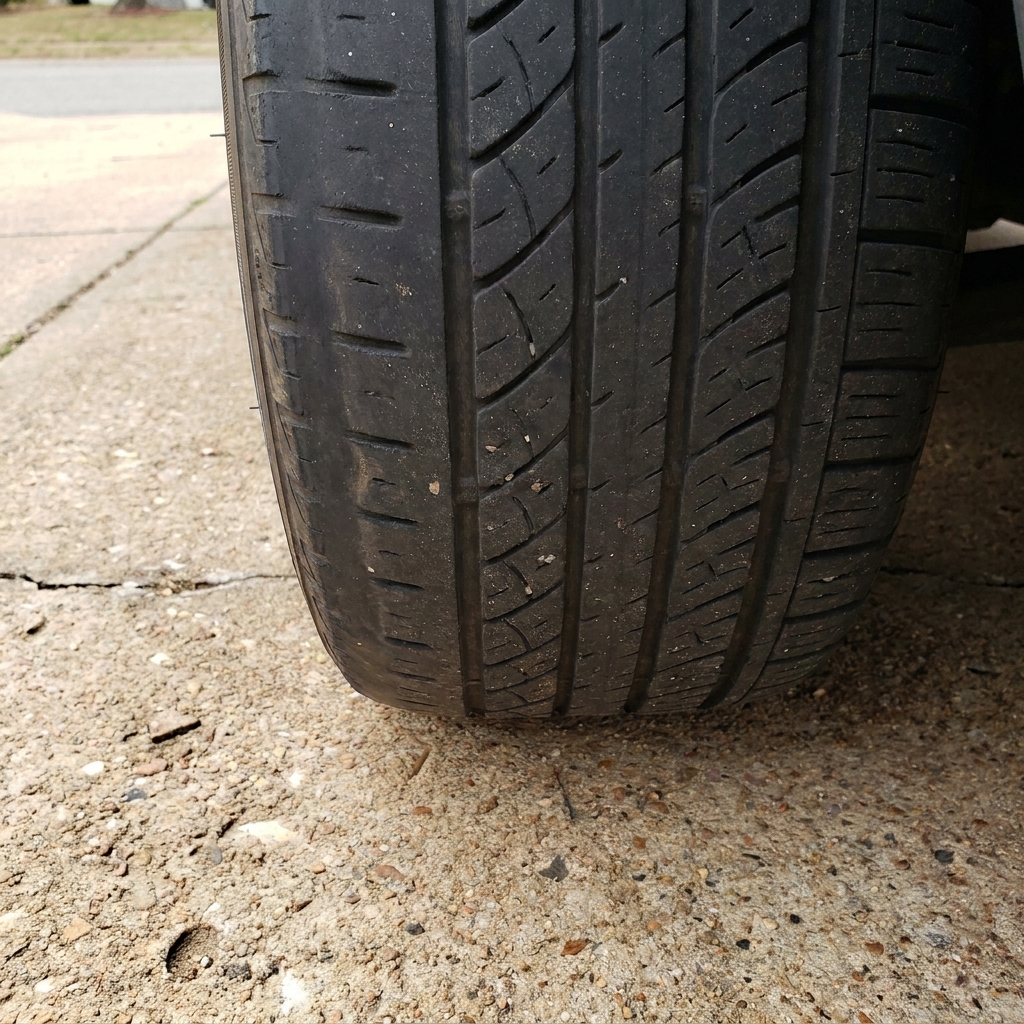
Before you diagnose anything: how to inspect tread the right way
Do this first so you do not chase ghosts.
Tools that help
- Tread depth gauge (cheap and worth it)
- Flashlight
- Tire pressure gauge (not the gas station one if you can help it)
- Chalk or a paint marker to mark problem spots
Quick inspection steps
- Park on level ground, set the parking brake, and turn the steering to full lock each direction so you can see inner and outer shoulders on the fronts.
- Check pressure when tires are cold. Compare to the driver’s door jamb sticker, not the tire sidewall.
- Measure tread depth in three lanes across the tire: inner, center, outer. Write the numbers down. Uneven depth is the clue.
- Run your hand over the tread. Feel for cupping, feathering, or high and low spots.
- Compare left vs right on the same axle. Big differences often mean an alignment or worn part, not just “bad tires.”
Safety note: If you see cords, a bulge, or deep cracking, stop diagnosing and start planning a tow. Those are failure signs, not “patterns.” Only move the vehicle if you have to, at very low speed for a very short distance.
Wear patterns and what they usually mean
Think of these patterns as symptoms. One symptom can have a couple causes, so I’ll give you the most likely culprits and the next check to do.
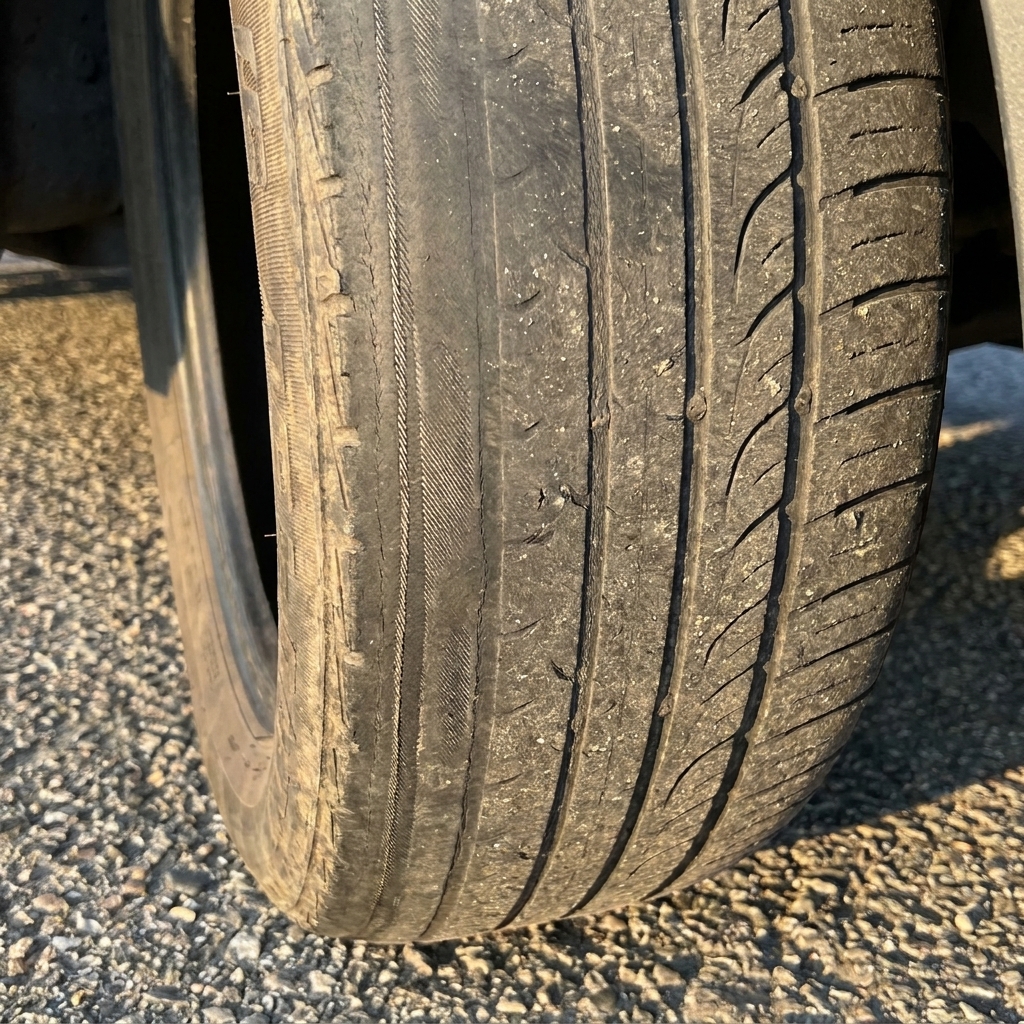
Inner edge wear (inside shoulder is bald, rest looks decent)
Common causes:
- Too much negative camber (top of the tire leaning inward)
- Toe out (tires pointing away from each other slightly, scrubbing the inner edges)
- Worn suspension parts that let camber or toe change while driving, like control arm bushings or ball joints
What to do next: If both front tires are wearing on the inside, an alignment check is likely overdue. If it is mostly one tire, suspect a worn component on that corner. Have a shop check for play before aligning, because an alignment will not hold if parts are loose.
Outer edge wear (outside shoulder is worn down)
Common causes:
- Too much positive camber (top of the tire leaning outward)
- Toe in (tires pointing toward each other, scrubbing)
- Hard cornering or lots of roundabouts and ramps in daily driving
- Chronic underinflation or overload can also chew shoulders, especially on heavier vehicles or frequent towing
What to do next: Verify pressure first. If the wear is mainly on one shoulder, alignment or driving style is a prime suspect. If you are seeing both shoulders wear on the same tire, think pressure, load, and heat first, then consider alignment if pressures and load have been right.
Center wear (middle of the tread worn, shoulders look better)
Common cause: Chronic overinflation.
Too much pressure can crown the tread, meaning it bows slightly so the center carries more load and wears faster. On modern radials, it usually takes sustained overinflation (and often long rotation intervals) to show a strong center-wear pattern.
What to do next: Set cold pressure to the door jamb spec and monitor over a few weeks. If your tire shop set pressures to the sidewall max, that is not correct for normal driving. Sidewall max is the tire’s limit, not your car’s recommended pressure.
Both shoulders worn (inner and outer edges worn, center looks better)
Common cause: Underinflation or overload.
Low pressure makes the tire ride on its shoulders. This is extra common when seasons change, because pressure drops when temperatures drop. Carrying heavy loads or towing can speed it up.
What to do next: Inflate to spec, then look for a slow leak. If you are adding air more than once a month, you likely have a nail, bead leak, or a tired valve stem. Also remember that temperature swings can move pressures around, so check on a consistent schedule.
Feathering (tread feels sharp in one direction and smooth in the other)
Run your palm lightly across the tread. If it feels like little ramps, that is feathering.
Common cause: Toe misalignment (toe in or toe out), often from a pothole hit, curb kiss, or worn tie rod ends.
What to do next: Schedule an alignment check. Toe is the angle that eats tires the fastest because it is basically sanding the tread as you drive.
Cupping or scalloping (dips around the tread, tire gets noisy)
Common causes:
- Worn shocks or struts (tire bounces instead of staying planted)
- Loose suspension (wheel bearing play, worn ball joints, worn bushings)
- Out-of-balance tires can contribute, though cupping is often damping or looseness first
What to do next: If the car feels floaty, bouncy, or unstable over bumps, do not just align it. Get the suspension inspected. Then balance and align after the worn parts are replaced.
One-sided patch wear (random bald spots)
Common causes:
- Hard braking flat spots (a brief lockup event can grind a section of tread down, even with ABS in some cases)
- Severe imbalance or a bent wheel
- Wheel bearing issues letting the wheel wobble
- Dragging brake hardware causing excess heat and accelerated, uneven wear
What to do next: Pay attention to smell and heat. After a normal drive, carefully hover your hand near each wheel. If one wheel is noticeably hotter, you may have a dragging brake. That is a fix-now issue.
What alignment angles have to do with tire wear
Alignment is a handful of angles, but the big three you will see on most printouts are camber, toe, and caster. On many vehicles, rear alignment and thrust angle matter too, especially for tracking straight and a centered steering wheel.
Camber
Camber is the inward or outward tilt of the tire when viewed from the front of the vehicle.
- Too much negative camber often wears the inner edge.
- Too much positive camber often wears the outer edge.
Some vehicles run a little negative camber on purpose for handling. The giveaway that it is too much is rapid shoulder wear that rotation cannot keep up with.
Toe
Toe is whether the front of the tires point inward or outward when viewed from above.
- Toe problems commonly cause feathering and fast wear across the whole tread.
If I could pick one angle to keep in check for tire life, it is toe.
Caster
Caster is the forward or backward tilt of the steering axis. It affects stability and steering return-to-center more than it affects tread wear.
- Caster issues often show up as pulling or a steering wheel that feels “off” after a hit.
You can have a caster issue without obvious tire wear, but it is still worth correcting for safe, predictable steering.
Driveway checks before you pay for an alignment
I love alignments, but I love not wasting money more. Here are quick checks that can tell you whether an alignment will actually solve the problem.
1) Check pressures and look for a slow leak
If pressures have been wrong, fix that first and start tracking. A tire that lives at 26 psi when it should be 35 psi will tell a scary story on the shoulders.
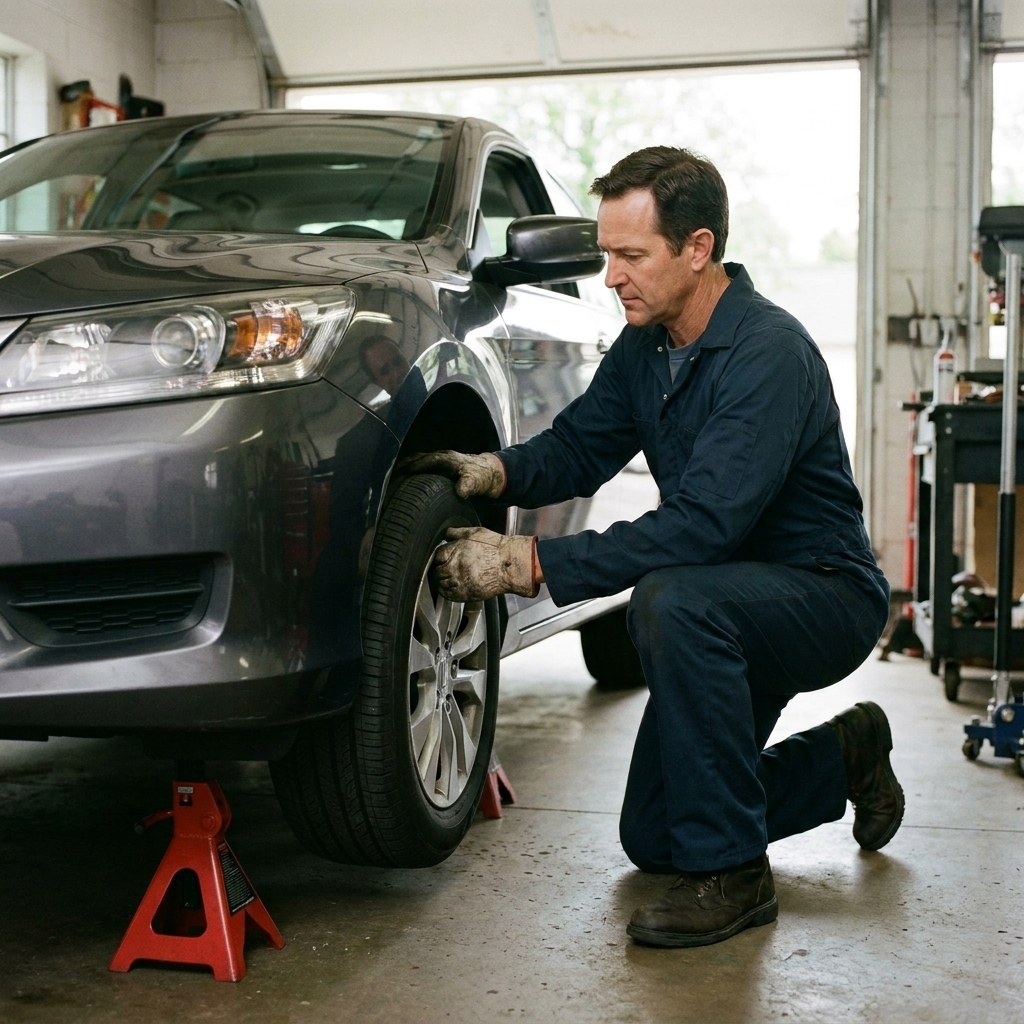
2) Look for obvious suspension play
If you are comfortable lifting the vehicle, do a basic wiggle test.
- Safely lift and support the car with jack stands on proper points.
- Grab the tire at 3 and 9 o’clock. Wiggle. Excess play can point to tie rods.
- Grab at 12 and 6 o’clock. Wiggle. Play can point to ball joints or wheel bearings depending on the design.
If anything clunks, an alignment can be temporary at best.
3) Do a quick bounce check
Push down firmly on a corner of the car and let go. If it keeps oscillating, it can be a hint your shock or strut is weak. This is a rough clue, not a perfect test on modern suspensions, so trust driving symptoms like extra bouncing, instability, or cupping more than the bounce test alone.
4) Watch for steering wheel clues
- Steering wheel off-center on a straight road: toe is often off, or the car has a rear thrust angle issue that is steering the whole vehicle slightly sideways.
- Car pulls: could be alignment, could be tire conicity, could be a dragging brake. Swap front tires left to right if directional rules allow. If the pull changes direction, suspect tires.
When tire wear is not an alignment problem
Not every ugly tread pattern is camber or toe. A few common look-alikes:
Out-of-balance tires
Often felt as a vibration at certain speeds. It can create choppy wear over time, especially if combined with weak shocks.
Bad rotation habits
Front tires on front-wheel-drive cars work harder. If you never rotate, the fronts will look rough while the rears look new. Rotation does not fix alignment, but it prevents normal wear from becoming extreme. A good baseline is rotating every 5,000 to 7,500 miles, or whenever your manual calls for it.
Cheap tires with soft tread blocks
Some budget all-seasons feather or cup more easily, especially on heavier vehicles. If your alignment is perfect but the tires get noisy early, tire quality can be part of the story.
Aggressive driving and heat
Hard cornering, repeated panic stops, or frequent high-speed driving can accelerate shoulder wear and create “melted” looking edges on performance compounds.
What to do once you spot a pattern
If the wear is mild
- Correct pressures.
- Rotate tires if the wear pattern and tire type allow it.
- Schedule an alignment check soon, especially if you see feathering or the steering wheel is off-center.
If the wear is severe
- Do not wait. Severe inner-edge wear can hide until cords show, and that can blow out at highway speeds.
- Inspect suspension parts first, then align.
- Plan on replacing the tires if they are near wear bars or damaged. Alignments do not regrow rubber.
After an alignment
Ask for the before-and-after printout. You do not need to understand every number, but you should see values moved into the green range, and you should see toe corrected. If your car has adjustable rear alignment, make sure the rear is checked too, because rear thrust angle can set your steering wheel off-center even when the front looks fine. Then keep an eye on tread depth every month or two. Your tires will tell you if the fix worked.
FAQ
How fast will a bad alignment ruin tires?
If toe is significantly off, you can scrub off a noticeable amount of tread in a few thousand miles. Camber wear can be slower, but it can also destroy an inner edge quietly while the rest of the tire looks fine from a casual glance.
Should I get an alignment every time I buy tires?
It is smart insurance. At minimum, get an alignment check when you install new tires if the old set wore unevenly, if you hit a major pothole, if you replaced steering or suspension parts, or if the car pulls or the steering wheel is off-center.
Can I just rotate tires to fix uneven wear?
Rotation can spread the wear around and buy time, but it does not fix the underlying cause. If you have feathering, inner-edge wear, or cupping, rotation alone is like moving a leaky roof stain to a different room.
Is inner tire wear always camber?
No. Inner-edge wear is often camber, but toe out can also do it, and worn bushings can cause dynamic toe changes while driving. That is why a suspension inspection matters when wear is one-sided or rapid.
What tread depth means it is time to replace?
Most tires are considered worn out at 2/32 inch (the wear bars). For wet safety, many drivers choose to replace closer to 4/32. For snow traction, 6/32 is a common guideline. If you see cords, bulges, or structural damage, replace immediately regardless of depth.
My garage takeaway
If you remember one thing, make it this: toe eats tires fast, camber eats tires quietly. Check pressures, measure tread in three lanes, and trust what the rubber is telling you. Tires are expensive. A simple alignment, or a $40 bushing caught early, is a whole lot cheaper than buying four new tires because the inside edges vanished without warning.