If your engine is shaking at a stoplight, stumbling under load, or flashing the check engine light like it is trying to get your attention (because it is), odds are you are dealing with a misfire. The good news: on a lot of modern cars, the most common misfire culprits are spark plugs and ignition coils, and both are very doable driveway jobs if you go step-by-step.
I spent years watching people get sold an expensive “tune-up package” when all they needed was a set of plugs and one coil. This guide will help you read the codes, verify the problem, and replace parts confidently without throwing money at guesses.

What a misfire feels like and why it matters
A misfire means one cylinder is not contributing like it should. That can happen because the air-fuel mix is wrong (fuel or vacuum issue), compression is low (mechanical issue), or the spark is weak or missing (ignition issue). We are focusing on that last one.
Common misfire symptoms
- Rough idle, especially in gear at a stop
- Hesitation on acceleration or climbing hills
- Loss of power and sometimes a “putt-putt” exhaust note
- Poor fuel economy
- Flashing check engine light (this is urgent)
A flashing check engine light is urgent
A flashing CEL usually means the misfire is bad enough to dump unburned fuel into the catalytic converter. That overheats the cat and can turn a simple plug-and-coil job into a four-figure exhaust repair. If the light is flashing, drive gently, avoid hard acceleration, and fix it soon.
Misfire codes: what P0300 through P0308 mean
You do not need a thousand-dollar scan tool to get started. A basic OBD2 code reader is often enough to point you toward the cylinder that is unhappy, especially if you get a cylinder-specific code. Some cars will still hide details behind P0300 unless you have a scanner that can show pending codes, live misfire counters, or on-board test results (Mode $06).
Quick code decoder
- P0300: Random or multiple cylinder misfire. Often plugs, coils, vacuum leaks, fuel issues, or multiple weak cylinders.
- P0301: Cylinder 1 misfire
- P0302: Cylinder 2 misfire
- P0303: Cylinder 3 misfire
- …and so on (P0304, P0305, P0306, P0307, P0308)
If you get a specific cylinder code like P0303, that is great. It gives you a target to test. If you get P0300, you can still work methodically, but be more cautious about assuming it is a single coil.
Freeze frame data helps (if your scanner shows it)
Freeze frame is a snapshot of what the engine was doing when the code set. Note:
- Engine coolant temp (cold start misfires can point to ignition weakness)
- Engine load and RPM (misfire only under load can point to a weak coil)
- Fuel trims (big positive trims can hint at a vacuum leak)
Tools and parts to have ready
Nothing kills DIY confidence faster than getting halfway in and realizing you are missing one socket. Here is the usual list.
Tools
- OBD2 scanner or code reader
- Basic ratchet set (including the famous 10mm)
- Spark plug socket (often 5/8" or 14mm, sometimes 9/16") with rubber insert or magnet
- 6" and 12" extensions, plus a swivel (helps on V6 and V8 engines)
- Torque wrench (highly recommended)
- Small pick or flat screwdriver (for connector tabs, gently)
- Compressed air or a can of air (to clean plug wells)
Supplies
- Dielectric grease (optional and used sparingly)
- Anti-seize (usually not needed on modern plated spark plugs, see below)
- Shop towels and a flashlight
Parts
- Spark plugs with the correct part number for your engine (correct heat range, too). Skip the “performance” stuff unless your manual calls for it.
- Ignition coil(s) if testing points to a bad one, or if you are doing a set for age-related reliability
Tip from the trenches: If your engine uses coil-on-plug (one coil per cylinder), replacing one failed coil is fine. But if the car has high miles and multiple coils are the same age, it is not crazy to budget for more than one over time.
Diagnose coil vs plug without guessing
Before you buy parts, do a couple simple checks. Your goal is to prove whether the problem follows the coil, follows the plug, or does not follow either.
1) Confirm cylinder numbering
Cylinder 1 is not always the one closest to the radiator. Look up a cylinder numbering diagram for your exact engine. Getting this wrong wastes time and money.
2) Do a quick visual inspection
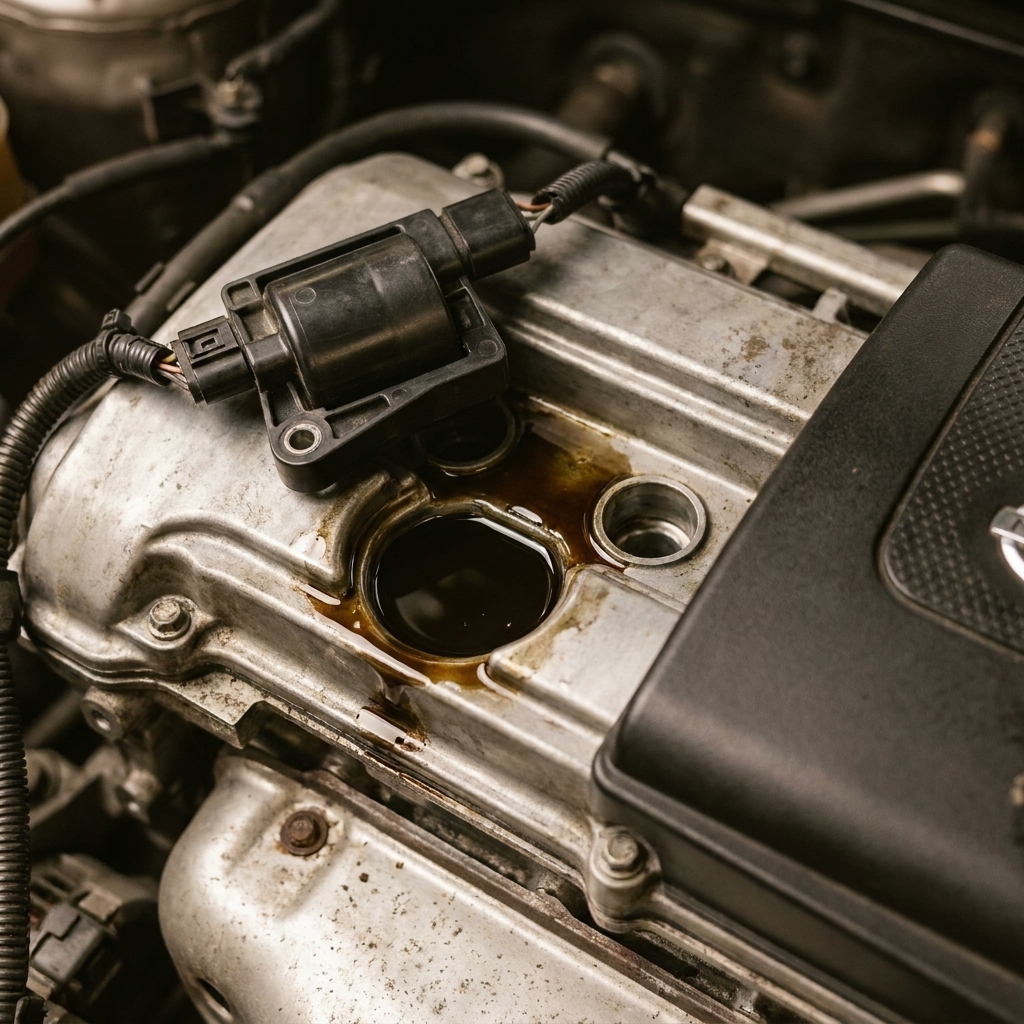
- Look for cracked coil boots, water intrusion, oil in the spark plug wells, or broken connectors.
- Check for loose intake tubes and obvious vacuum leaks.
- If you see oil in the plug well, you may have a valve cover gasket or tube seal leak. Fixing plugs without addressing oil contamination often leads to repeat misfires.
3) Swap test (best driveway test for coil-on-plug)
If you have a code like P0302 (cylinder 2 misfire):
- Move the coil from cylinder 2 to another cylinder (say cylinder 4).
- Clear codes.
- Drive until the misfire comes back and a code resets, or until your scanner shows the misfire moved.
Results:
- If the code moves to P0304, the coil is the likely culprit.
- If it stays P0302, the coil is probably not the issue. Next step is swapping the spark plug or looking at fuel and mechanical causes.
4) Swap the spark plug (if the coil test did not move the misfire)
Same idea:
- Move the spark plug from the misfiring cylinder to another cylinder.
- Clear codes and re-test.
If the misfire follows the plug, you found your problem.
5) Read the old spark plug like a mechanic would
When you pull the plug, take 30 seconds to look at it. Also pay attention to where you see oil, because oil on the outside and oil on the firing end mean different things.
- Normal: light tan or gray deposits, even wear
- Worn gap: rounded center electrode, wide gap, weak spark
- Oil in the plug well or on the boot: oil pooled around the plug or soaking the coil boot (usually a valve cover gasket or tube seal issue)
- Oily deposits on the firing end: wet, oily tip/electrode (often internal oil consumption like rings or valve guides, sometimes PCV issues)
- Fuel fouling: sooty black tip (can be rich running, weak ignition, short trips)
- White blistered tip: overheating or lean condition (investigate before tossing parts)
Replace spark plugs the clean, careful way
If your plugs are due by mileage or your diagnosis points to them, replace them as a set. Mixing old and new plugs is like putting one new sneaker on and wondering why the walk feels weird.
1) Work on a cool engine
Aluminum heads and hot spark plugs do not mix. Let the engine cool fully to reduce the chance of thread damage.
2) Disconnect the battery (recommended)
It is not always required, but if you are working around wiring and metal tools near the engine harness, I like the extra safety. Remove the negative terminal and keep it from springing back.
3) Remove coils (or plug wires) and clean the area
On coil-on-plug setups:
- Unplug the coil connector. Release the lock tab first and pull the connector housing, not the wires.
- Remove the coil bolt (often 8mm or 10mm).
- Twist the coil slightly and pull it straight out.
Before removing the spark plug, blow out debris around the plug well. Dirt falling into the cylinder is a bad day.
4) Remove spark plugs carefully
Use the spark plug socket and extension and keep it as straight as you can so you do not crack the porcelain. Apply steady force. If a plug feels stuck, do not gorilla it. Tighten slightly, then loosen, and work it out gradually.
5) Check the gap, but know what you have
Many modern plugs come pre-gapped and should not be bent around aggressively, especially fine-wire iridium plugs. Still, compare the gap to spec. If it is wildly off, exchange the plug.
6) Anti-seize and spark plugs: a quick reality check
Most modern spark plugs have plated threads and do not require anti-seize. Adding it can cause over-torquing because it changes friction. Follow the plug manufacturer’s guidance and your service manual. If you do use a tiny amount, keep it off the first thread and the electrode end.
7) Install by hand first, then torque
Start the plug threads by hand using an extension only (no ratchet) so you can feel cross-threading before it becomes expensive. Once seated, torque to spec.
No torque wrench? Use the spark plug manufacturer’s “turn after seat” guidance for your plug and cylinder head type. A torque wrench is the better move.

Replace ignition coils without repeat mistakes
Ignition coils are simple parts, but there are a few easy mistakes that cause repeat misfires.
1) Match the right coil to the right cylinder
If you are only replacing one coil, put the new one exactly where the bad one was. If you are doing multiple coils, set them out in order so you do not mix up boots or hardware.
2) Inspect and replace boots if needed
Some coils come with a new boot, some do not. A torn or carbon-tracked boot can leak spark even if the coil is fine.
Look for: thin lightning-bolt looking marks (carbon tracking), cracks, or a swollen boot.
3) Dielectric grease: less is more
A small smear inside the boot can help sealing and future removal. Do not pack the boot full. Dielectric grease is an insulator, and you do not want it interfering with the contact.
4) Torque coil bolts lightly
Coil hold-down bolts do not need much torque. Stripping valve cover threads is painfully common. Snug to spec.
5) Reconnect everything like you mean it
Make sure each connector clicks and each harness is routed away from hot exhaust parts. A loose connector can mimic a failed coil.
After the install: verify the fix
1) Clear codes
Clear the codes with your scanner after repairs. If you do not, the check engine light might stay on for a while even though the problem is fixed.
2) Test drive with purpose
Drive in the conditions that used to trigger the misfire:
- Idle in gear for a minute or two
- Light acceleration
- Moderate acceleration up a hill if that used to cause stumbling
If you have a scanner that shows misfire counters or Mode $06 on-board test results, watch for counts on the previously affected cylinder.
3) If it still misfires
If the misfire did not change after plug and coil work, keep your cool. That usually points to:
- Fuel injector issue (clogged or electrically failing injector)
- Vacuum leak near that cylinder runner
- Compression problem (burned valve, ring issue)
- Wiring problem to the coil or injector
At that point, a compression test or leak-down test is a smart next step, or it may be time to bring in a trusted shop for deeper diagnostics. If your engine is known for a repeat misfire issue, a quick search for TSBs and common failures for your exact year and engine can save a lot of wheel-spinning.
Mistakes that create new problems
- Cross-threading a spark plug: always start by hand, no ratchet.
- Over-torquing plugs: can crack the plug or damage threads.
- Mixing up coils: changes your diagnosis trail if you are swapping parts to test.
- Forgetting to clean debris from plug wells: grit in the cylinder is bad news.
- Ignoring oil in plug wells: oil-soaked boots and plugs often re-misfire until the gasket or tube seals are fixed.
- Buying the cheapest no-name coils: ignition parts live a hard life. Stick with OE, OEM supplier brands, or reputable aftermarket.
FAQ
Should I replace all ignition coils at once?
Not always. If one coil failed and the others are working, replacing just the bad one is reasonable. If your car has very high mileage, you are planning a long trip, or multiple coils are failing within a short span, replacing a full set can be a reliability play.
Can bad spark plugs damage ignition coils?
Yes. Excessive plug gap and worn electrodes force the coil to work harder to jump the gap. Over time, that extra stress can shorten coil life.
My code is P0300. Can spark plugs and coils still be the cause?
Absolutely. P0300 can happen when multiple plugs are worn, multiple coils are weak, or the engine is running lean due to a vacuum leak. Start with basics: check for vacuum leaks and verify plug condition and service interval.
Do I need to gap iridium spark plugs?
Many iridium plugs come pre-gapped and the fine-wire center electrode can be damaged if you force-adjust it. Always compare the plug gap to your spec. If it is off by a lot, exchange the plug for another one that is within spec.
Is a misfire always ignition related?
No. Spark is a common cause and the easiest DIY fix, but misfires can be fuel, air, or compression related. If the misfire does not follow a coil or plug in swap testing, widen your diagnosis.
My go-to approach for the simple win
If you want the short version I used in the shop: pull codes, identify the cylinder, do a swap test on the coil, check the plug condition and gap, then replace what actually failed. Tighten things to spec, keep your work clean, and you will usually get that smooth idle back the moment you turn the key.
And if you are nervous, that is normal. Everyone starts somewhere. The difference between “I am not a car person” and “I fixed my own misfire” is usually one careful Saturday and the willingness to take it one bolt at a time.